
Hiring a duct cleaning contractor on the Delmarva Peninsula starts with one question: does the company clean to a verified standard, or does it just claim to? The NADCA ACR standard, published by the National Air Duct Cleaners Association, is the industry benchmark that answers that question. It mandates source removal. That method physically extracts contaminants from inside ductwork rather than blowing debris around the system. Homeowners in Worcester County MD, Wicomico County MD, and Sussex County DE can use the ACR standard as a checklist to evaluate any contractor’s equipment, process, and documentation before signing a work order.
Source removal reduces the particulate load recirculating through the HVAC system, which is the measurable indoor air quality outcome the standard targets. 5 Star Plumbing Heating and Cooling is a two-state licensed HVAC contractor serving all three counties with source removal equipment that meets ACR specifications for negative pressure collection and HEPA filtration.
What Is the NADCA ACR Standard?
The NADCA ACR standard is the internationally recognized benchmark for HVAC system cleaning, published by the National Air Duct Cleaners Association, that defines source removal as the only acceptable method for extracting contaminants from ductwork. The EPA does not regulate duct cleaning directly and instead points consumers to industry-developed standards like ACR for evaluating contractor quality.
ACR stands for Assessment, Cleaning, and Restoration. NADCA published the first edition in 1992 to establish procedural and performance requirements for inspecting, cleaning, and restoring HVAC systems. The 2025 edition is the current version. That edition covers both residential and commercial systems, and it is the standard specified on commercial projects worldwide where building owners require documented proof that cleaning met a recognized performance threshold.
NADCA represents over 1,600 HVAC inspection, cleaning, and restoration professionals through its membership program. The association also publishes the DEDP Standard (Dryer Exhaust Duct Performance), which governs dryer vent cleaning as a separate discipline from HVAC duct cleaning. ACCA (Air Conditioning Contractors of America) sets complementary standards for HVAC system design and installation, but ACR is the standard that governs how those systems are cleaned after they are in service.
The EPA has stated that no conclusive evidence proves duct cleaning alone prevents health problems. That position means the agency does not require routine duct cleaning and does not publish its own regulations for the process. The gap is intentional. Instead of setting its own standards, the EPA points consumers to industry-developed benchmarks like ACR when they need a framework to evaluate whether a contractor’s methods meet an accepted quality threshold.
Visible mold growth inside ductwork or on HVAC components, evidence of rodent or insect infestation, and substantial debris visibly restricting airflow are the only triggers the EPA identifies. Outside those conditions, the decision to clean is the homeowner’s, and the ACR standard is the evaluation tool the EPA directs them toward.
What Does Source Removal Mean in Duct Cleaning?
Source removal is the process of physically dislodging contaminants from interior duct surfaces using mechanical agitation while simultaneously extracting the loosened debris through negative pressure collection into a sealed containment or HEPA filtration system. NADCA designates source removal as the only acceptable method for cleaning HVAC systems under the ACR standard.
Mechanical agitation is the first of two simultaneous actions. A technician inserts specialized agitation tools into the ductwork to physically break contaminant deposits loose from the interior surfaces of each duct run. Rotary brushes spin against duct walls to scrub adhered dust, mold, and debris free. Pneumatic air whips, also called air whips, use compressed air pulses to dislodge particles from duct surfaces, joints, and corners that brushes cannot reach.
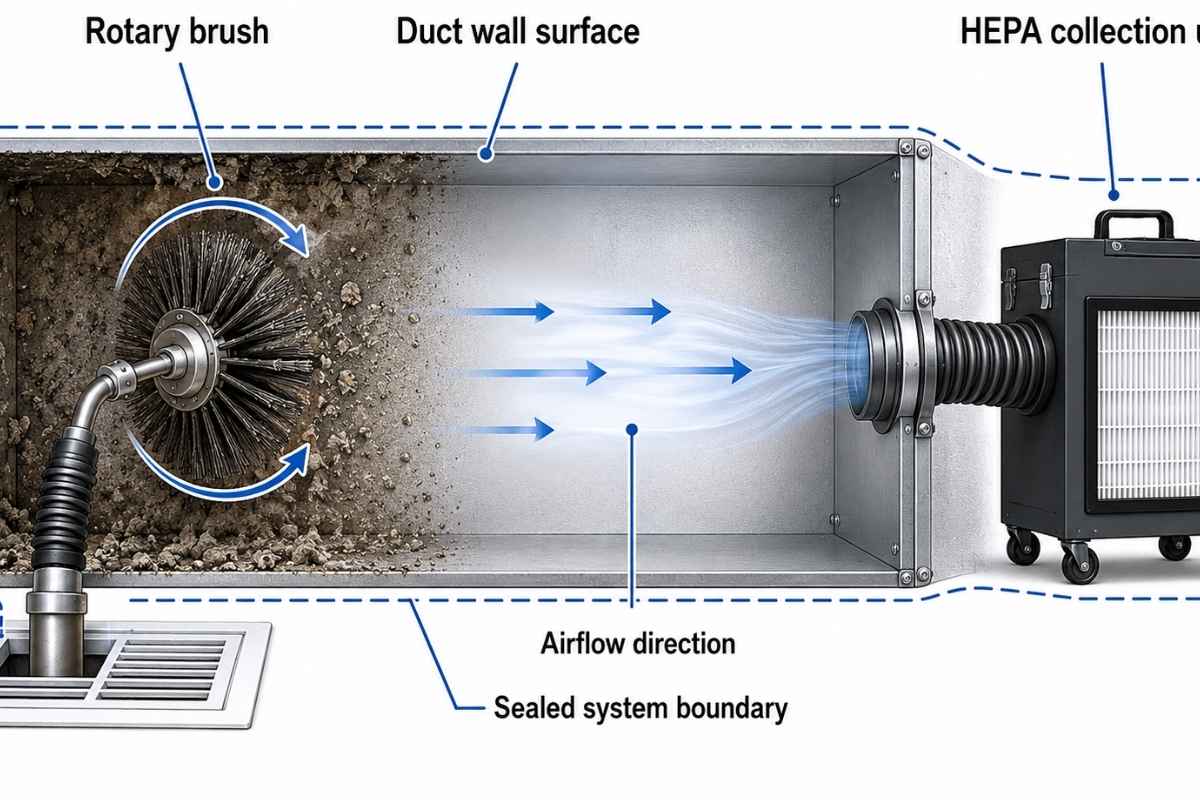
While agitation occurs, a truck-mounted vacuum or portable HEPA vacuum creates negative pressure inside the sealed duct system, drawing air inward toward the collection unit rather than outward into the building. That pressure differential pulls every loosened particle directly into sealed containment or through HEPA filtration rated to capture 99.97% of particles at 0.3 microns. No debris enters occupied rooms because the airflow direction never reverses during the cleaning process.
Non-compliant methods, commonly called blow-and-go cleaning, skip mechanical agitation entirely. These operations use underpowered equipment that pushes air through the duct system without physically extracting embedded contaminants from duct surfaces. The visible surface of register covers may look clean afterward. The interior duct walls remain untouched.
Some blow-and-go operators spray chemical foggers or sealants into the ductwork as a substitute for physical extraction. The chemicals coat interior surfaces without removing the underlying debris, and some formulations introduce volatile compounds that become new irritants circulating through the HVAC system. The ACR standard rejects any method that does not include physical source removal from duct surfaces. A contractor who offers chemical treatment without first performing mechanical agitation and negative pressure extraction is not operating to the standard, regardless of what the marketing materials claim.
When Does Your HVAC System Actually Need Duct Cleaning?
Duct cleaning is warranted when specific contamination conditions exist inside the HVAC system, not on a fixed calendar schedule. The EPA recommends cleaning only when visible mold growth, vermin infestation, or excessive debris restricting airflow is present, and Delmarva Peninsula homes face additional humidity and seasonal occupancy factors that increase the probability of these trigger conditions.
The EPA identifies three primary conditions that warrant duct cleaning, plus one post-event trigger. Each condition requires visual or physical evidence inside the ductwork, not a suspicion based on system age or time since last cleaning.
- Visible mold growth on interior duct surfaces, on the evaporator coil, or on other HVAC components that contact conditioned air. Surface discoloration alone does not confirm mold — laboratory testing of a sample is the only definitive identification method.
- Rodent or insect infestation with physical evidence inside the ductwork, including droppings, nesting material, carcasses, or insect casings found during inspection.
- Excessive dust or debris visibly restricting airflow through supply or return registers, or visible particles being discharged into occupied spaces when the system operates.
- Post-renovation construction dust deposited throughout the duct system during remodeling work where the HVAC was not sealed or isolated from the construction area.
Calendar-based cleaning is not an EPA position. NADCA recommends homeowners have their HVAC systems inspected every 3 to 5 years by a qualified professional who assesses the system’s actual condition before recommending any cleaning work. The inspection determines whether any of the four trigger conditions exist. A system with no contamination evidence does not need cleaning regardless of how many years have passed since the last service.
Delmarva Peninsula homes face environmental conditions that accelerate the development of EPA trigger conditions. The region’s coastal proximity to the Chesapeake Bay and Atlantic Ocean produces sustained high humidity from late spring through early fall, creating favorable conditions for mold colonization inside ductwork and on evaporator coils.
- Seasonal and vacation homes in Ocean City, Bethany Beach, and Rehoboth Beach that sit closed for weeks or months allow moisture to accumulate inside ductwork without the airflow that regular HVAC operation provides. Stagnant humid air inside sealed ducts is the primary driver of mold growth in unoccupied coastal properties.
- Older homes in Salisbury and Berlin undergoing renovation projects risk construction dust contamination if contractors do not seal HVAC registers and returns before demolition or drywall work begins.
- Homes using low-MERV filters (MERV 1 through MERV 4) in high-humidity environments allow finer particulate to pass through the filter media and accumulate on interior duct surfaces over time, increasing the debris load that triggers the EPA’s third condition.
- Properties near agricultural operations in Worcester and Wicomico Counties face seasonal particulate from field activity that enters the HVAC system through fresh air intakes and accumulates in ductwork beyond what standard filtration captures.
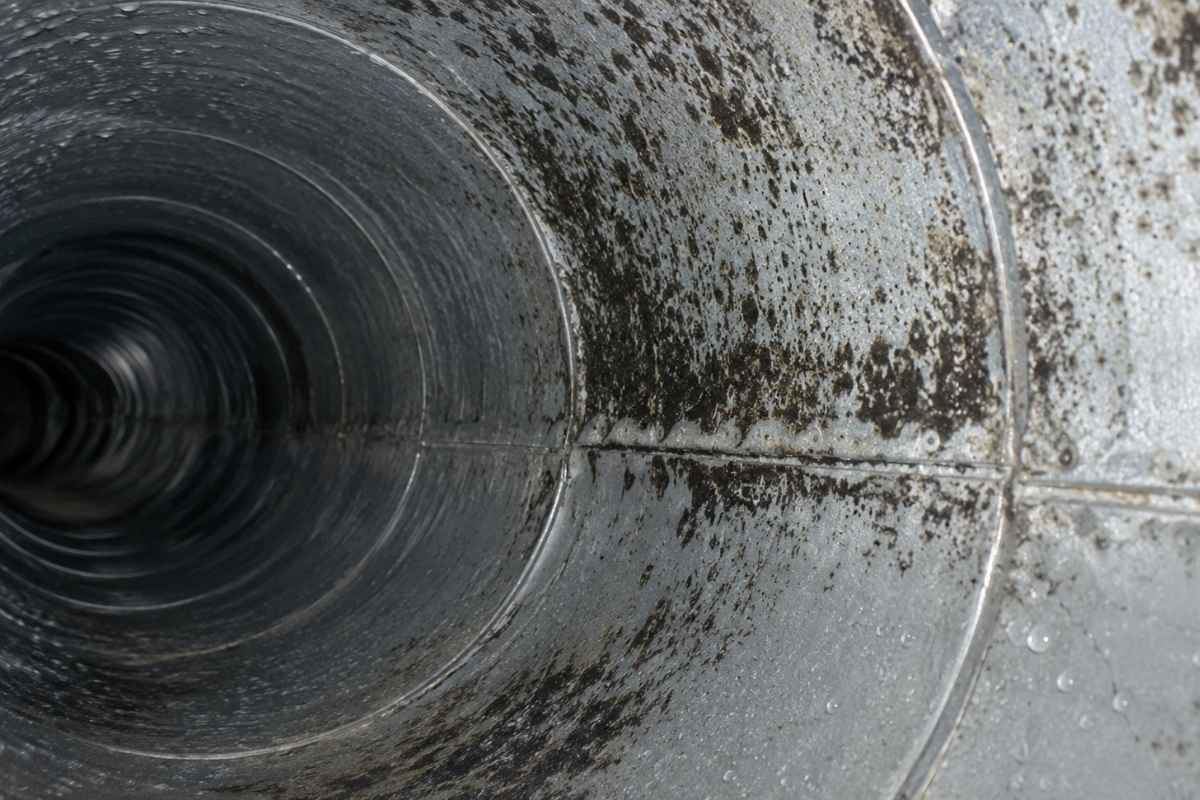
These local factors do not mean every Delmarva home needs duct cleaning. They mean the probability of EPA trigger conditions developing is higher in this region than in inland, low-humidity markets. A 3-to-5-year inspection cycle catches conditions early, before contamination reaches the level where system performance and indoor air quality degrade.
What Happens During a NADCA-Compliant Duct Cleaning?
A NADCA-compliant duct cleaning follows a three-phase process: pre-cleaning assessment with camera inspection and scope of work documentation, mechanical source removal under continuous negative pressure, and post-cleaning verification using visual re-inspection and cleanliness testing to confirm contaminant extraction meets ACR performance benchmarks. The three phases run in strict sequence because each phase depends on the documentation and conditions established by the one before it.
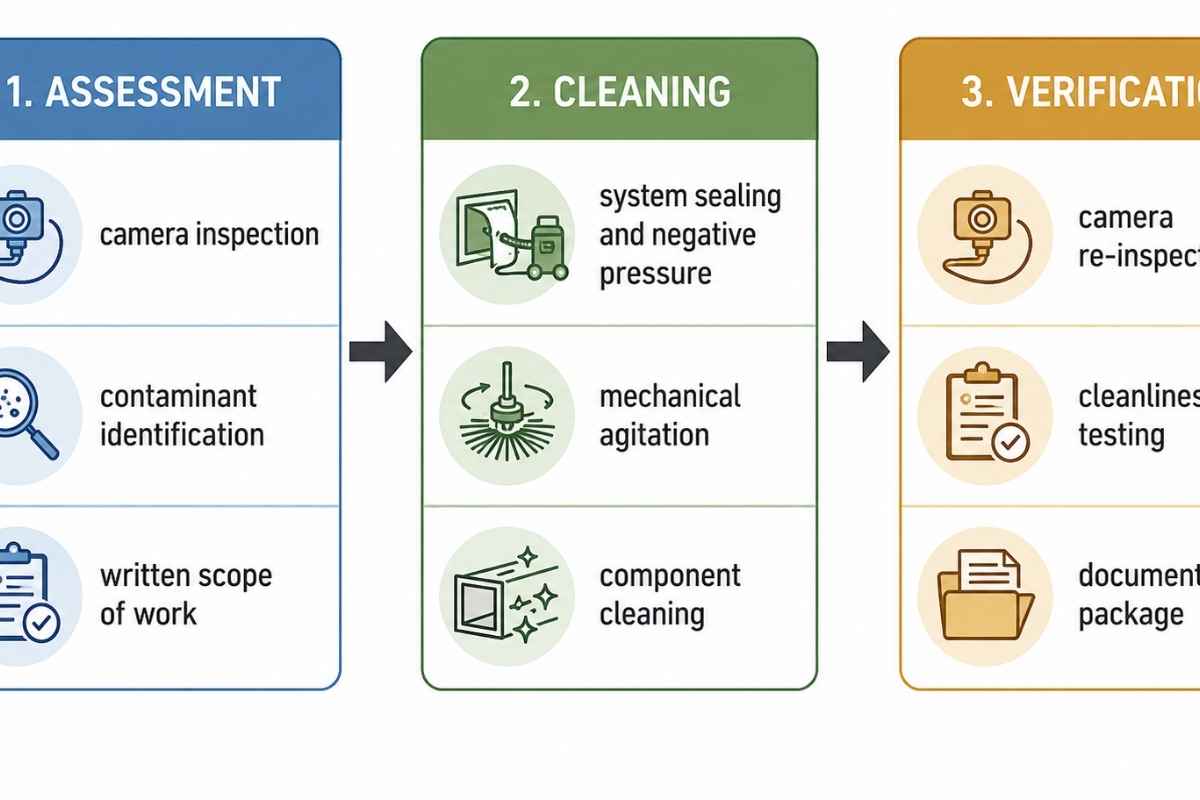
The assessment phase begins before any cleaning equipment is connected to the system. A qualified technician inspects the entire HVAC system and documents its condition before proposing any work, which gives the homeowner a baseline to verify against after cleaning is complete.
- Visual inspection of all accessible components — the technician examines supply ducts, return ducts, the air handler, evaporator coil, blower motor, and every register for visible contamination, damage, or moisture.
- Camera inspection of duct interiors — a remote camera is inserted into the ductwork to document conditions that are not visible from register openings, including interior surface contamination, joint separations, and obstruction points.
- Contaminant identification — the technician identifies the specific type of contamination present (dust accumulation, biological growth, pest evidence, construction debris) because each type may require different agitation tools or handling procedures.
- Written scope of work — the technician produces a document that names every component to be cleaned, the source removal methods to be used, the equipment involved, and the estimated timeline. No cleaning begins until the homeowner reviews and approves this scope.
The scope of work is the homeowner’s primary protection. It creates a written record that the technician and the homeowner agreed on before the job started. Any work performed outside the approved scope, or any component skipped that the scope included, is a contract deviation the homeowner can identify and challenge.
The cleaning and verification phases execute the scope of work and then prove the results. Two phases remain after assessment, and both must complete before the job is finished.
- System sealing and negative pressure establishment — the technician seals the duct system, connects the HEPA-filtered vacuum unit, and establishes continuous negative pressure before any agitation tools enter the ductwork, ensuring all loosened debris flows toward the collection unit.
- Mechanical agitation through each duct run — rotary brushes or pneumatic whips move through every supply line, return line, and branch identified in the scope, dislodging contaminants from interior surfaces.
- Component cleaning — registers, the evaporator coil, and the blower compartment are cleaned individually, since each component accumulates contamination differently and requires direct access.
- Post-cleaning camera re-inspection — the technician re-inserts the camera into the same duct sections documented during the assessment phase, capturing after images that pair directly with the before images from step 2 of the assessment.
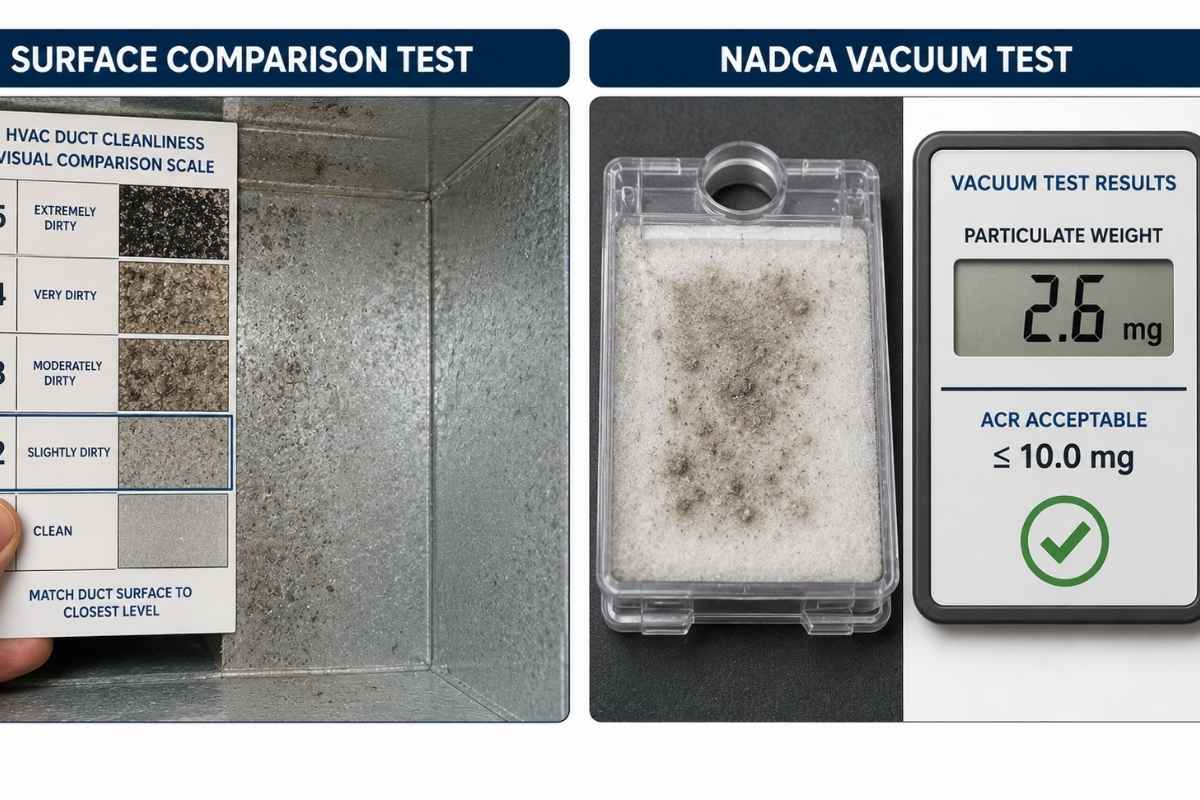
- Cleanliness verification testing — the technician performs a Surface Comparison Test or NADCA Vacuum Test to measure residual contaminant levels against ACR performance benchmarks. The test result is documented and provided to the homeowner alongside the before-and-after camera images.
A completed job produces a verification package: the original scope of work, before-and-after camera documentation, and the cleanliness test results. Any contractor who cannot deliver all three documents at the end of the service call did not complete an ACR-compliant cleaning.
What Is the Difference Between NADCA Membership and ASCS Certification?
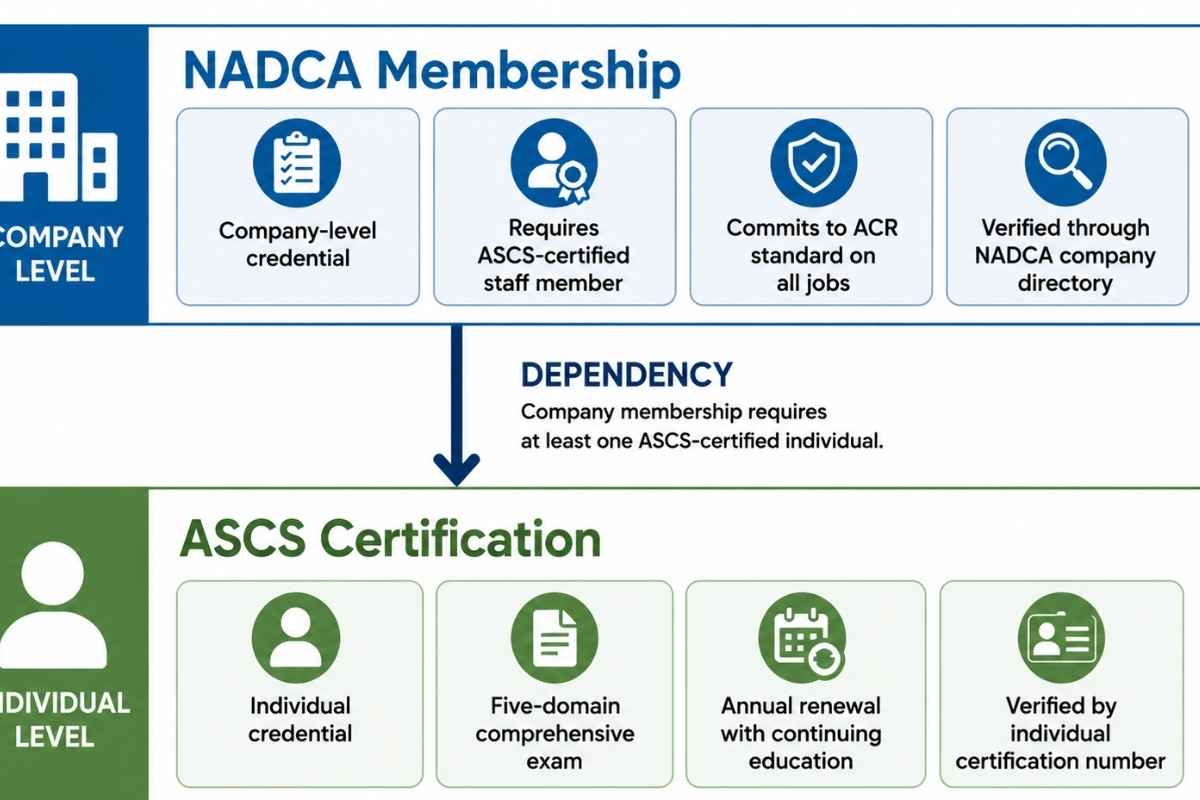
NADCA membership is a company-level affiliation that requires at least one certified Air Systems Cleaning Specialist (ASCS) on staff and adherence to the ACR standard, while ASCS certification is an individual credential earned by passing a comprehensive exam on HVAC system design, cleaning methodology, safety protocols, and indoor air quality. A company can claim to follow NADCA guidelines without holding membership or employing an ASCS-certified technician, making verification of the actual credential essential.
NADCA membership is held at the company level, not by individual technicians. To qualify, the business must employ at least one full-time staff member who holds an active ASCS certification, and that individual must be directly responsible for overseeing all duct cleaning projects the company performs. Membership also requires adherence to the ACR standard on every job, meaning the company commits to source removal as the only cleaning method.
The membership requirement creates a chain. Company membership depends on individual certification, and individual certification depends on passing the ASCS exam.
The duct cleaning industry has no federal regulation and no duct-cleaning-specific license in most states. That gap means anyone can advertise duct cleaning services without holding ASCS certification, NADCA membership, or any credential specific to the work. Many companies advertise that they follow NADCA guidelines or use NADCA methods without holding actual membership or employing a certified specialist, and no regulatory body prevents those claims.
| NADCA Membership | ASCS Certification | |
|---|---|---|
| Held by | Company | Individual technician |
| Requirement | Minimum one ASCS-certified staff member overseeing all projects | Passing a comprehensive exam on HVAC design, cleaning methodology, safety, and IAQ |
| Scope | Commits the company to ACR standard compliance on every job | Validates the individual’s technical knowledge across five subject domains |
| Renewal | Annual company membership renewal with continued ASCS employment | Annual individual renewal before June 30, with continuing education requirement |
| Verification | NADCA online member directory by company name | NADCA online directory by individual ASCS certification number |
| What it does not guarantee | That every technician on site holds individual certification | That the company follows ACR standards on every project |
The ASCS credential requires passing a comprehensive exam. The exam covers five domains: HVAC system design, contamination assessment, cleaning methodology, safety protocols, and indoor air quality science. Certification must be renewed annually before June 30 through a fee and a continuing education requirement that ensures the credential holder stays current with ACR revisions and industry developments.
NADCA also offers the Certified Ventilation Inspector (CVI) credential as an advanced certification for professionals who specialize in HVAC system inspection and diagnostics rather than cleaning execution.
The verification action is specific. Ask for the ASCS certification number of the technician who will oversee the project, not just the company’s NADCA membership status. Verify that number through NADCA’s online directory before the service appointment. A company can hold NADCA membership while sending an uncertified technician to perform the work, which is why the individual credential matters more than the company affiliation for the homeowner’s quality assurance.
How Do You Verify a Duct Cleaning Was Done Correctly?
Verify a completed duct cleaning by requesting before-and-after camera documentation of duct interiors, confirming the technician performed a Surface Comparison Test or NADCA Vacuum Test to measure residual contaminant levels against ACR benchmarks, and comparing post-cleaning static pressure readings against the system manufacturer’s specifications. These three verification categories cover surface cleanliness, system performance, and visual documentation.
Two standardized tests measure whether contaminant removal actually met ACR performance thresholds. Both tests produce a documented result measured against a printed ACR threshold on the test form, which means the homeowner does not need technical expertise to see whether the number passed or failed.
- Surface Comparison Test — the technician places a standardized visual scale against the interior surface of cleaned ductwork and compares the surface condition against reference images representing defined cleanliness levels. The result is a documented rating, not an opinion.
- NADCA Vacuum Test — the technician collects residual particulate from a defined area of cleaned duct surface using a calibrated vacuum cassette, then weighs the collected material and compares it against ACR weight thresholds for acceptable cleanliness.
- Static pressure measurement — a manometer reading taken at the air handler after cleaning measures system pressure in inches of water column. The reading is compared against the manufacturer’s specification to confirm the cleaning did not damage ductwork, collapse flexible runs, or leave obstructions that restrict airflow.
- Airflow measurement — CFM (cubic feet per minute) readings taken at supply registers after cleaning confirm that conditioned air delivery matches the system’s design capacity. A drop in CFM after cleaning indicates a problem the contractor must address before the job is complete.
The tests measure different things. Surface cleanliness tests confirm contaminant removal from duct walls, while pressure and airflow tests confirm the system still performs to the manufacturer’s specification. A compliant verification uses at least one surface cleanliness test and compares system performance against the manufacturer’s baseline.
The documentation package is the homeowner’s permanent record that the cleaning met the standard and that every component in the scope of work was addressed. Every document produced during the three-phase process should be collected and retained.
- Before-and-after camera images — paired photographs of the same duct sections, coil surfaces, and blower compartment documented during pre-cleaning assessment and again after cleaning is complete. The images must correspond to the same locations to be valid as comparison evidence.
- Scope of work with sign-off — the original document listing every component cleaned, the methods used, and the homeowner’s approval signature. This is the baseline the verification tests are measured against.
- Verification test results — the Surface Comparison Test rating or NADCA Vacuum Test weight measurement, documented with the date, technician name, and the ACR threshold the result was compared against.
- Post-cleaning system measurements — static pressure readings and CFM measurements with the manufacturer’s specifications noted for comparison. PM2.5 and PM10 readings, measuring respirable particulate matter in micrograms per cubic meter, provide an additional air quality data point when the contractor’s equipment supports particulate monitoring.
Four documents make a complete package. Any contractor who declines to provide these documents after a completed job has not delivered an ACR-compliant cleaning. The homeowner has grounds to dispute the work.
What Maryland and Delaware Rules Apply to HVAC Duct Cleaning?
Maryland requires HVACR contractors to hold a state license issued by the Maryland Board of HVACR Contractors under the Department of Labor, and Delaware requires licensure through the Delaware Board of Plumbing, Heating, Ventilation, Air Conditioning and Refrigeration Examiners under the Division of Professional Regulation. Neither state issues a duct-cleaning-specific license, but HVAC work involving system components beyond simple filter changes falls under these boards’ jurisdiction.
Maryland licenses HVACR professionals at the apprentice, journeyman, and master levels through the Board of Heating, Ventilation, Air Conditioning and Refrigeration Contractors. The Board operates under the Department of Labor pursuant to Business Regulation Article 9A and COMAR 09.15. The regulations define licensing requirements, scope of practice, and enforcement procedures for all HVACR work performed in the state. Homeowners who file complaints against a licensed contractor trigger a Board investigation that can result in license suspension, revocation, or civil penalties reaching $5,000 per violation. The enforcement mechanism gives Maryland homeowners a regulatory pathway that does not exist for unlicensed operators, which is one reason verifying active licensure before authorizing work matters.
No duct-cleaning-specific license exists in Maryland. Any work that involves accessing HVAC system components beyond a basic filter change falls under the HVACR licensing scope. A contractor performing source removal on ductwork, coils, and blower compartments is performing licensable HVACR work. Worcester County and Wicomico County homeowners should verify a contractor’s active Maryland HVACR license through the Department of Labor’s online license verification system before authorizing any duct cleaning.
Delaware licenses HVACR professionals through the Board of Plumbing, Heating, Ventilation, Air Conditioning and Refrigeration Examiners under the Division of Professional Regulation. The state licenses at apprentice, journeyman, and master levels, with master licensure requiring passage of the Master HVACR exam. Maryland and Delaware maintain license reciprocity for HVACR Master credentials, which means a contractor who holds a Master HVACR license in one state can qualify for equivalent licensure in the other without re-examination.
Reciprocity has a practical meaning for Sussex County homeowners. A two-state licensed contractor like 5 Star Plumbing Heating and Cooling has met the qualification standards of both regulatory boards independently, not just the board in the state where the company is headquartered. Any work involving refrigerant handling during duct cleaning or coil service requires federal EPA Section 608 certification, which applies regardless of state licensure.
How Do You Spot a Duct Cleaning Scam Before Hiring?
The most reliable indicators of a duct cleaning scam are whole-house cleaning prices significantly below market rate, refusal to perform a pre-cleaning inspection before quoting a price, no mention of negative pressure or source removal in the service description, and inability to provide an ASCS certification number for the technician overseeing the project. These indicators share a common pattern: they all point to contractors who skip the steps that ACR compliance requires.
Scam operations follow recognizable patterns that a homeowner can identify before any money changes hands. The red flags below appear consistently across the duct cleaning industry regardless of region, and each one signals a contractor who is not equipped or willing to perform source removal.
- Whole-house pricing at $99 or less — deploying a truck-mounted vacuum, HEPA filtration, and mechanical agitation tools costs more to operate per job than these companies charge for the entire service. The price signals that source removal equipment is not part of the operation.
- Door-to-door solicitation — unsolicited contact offering duct cleaning without a scheduled appointment is the most common entry point for blow-and-go operators. NADCA identifies unsolicited outreach as a primary warning sign.
- Flat-price quote without inspection — a contractor who quotes a price without visually inspecting the system has no basis for determining the scope of work, the contamination type, or the time required. The quote is a hook, not an estimate.
- Chemical fogging or sanitizing as the primary service — operators who advertise chemical treatment without mentioning source removal are coating contaminants rather than extracting them. The chemicals add cost without removing debris.
- Bait-and-switch pricing — the advertised price covers only a limited number of vents or registers, and the contractor adds per-vent charges on site that bring the total above market rate for legitimate source removal work.
The pattern is consistent. These operators profit by charging for work they do not perform and by avoiding the equipment investment that ACR compliance requires. Homeowners who encounter any one of these red flags should treat it as disqualifying, not as a starting point for negotiation.
Four verification steps confirm whether a contractor operates to the ACR standard before the homeowner commits to a service appointment. Each step takes minutes.
- Ask for the ASCS certification number of the technician who will oversee the project and verify that number through NADCA’s online member directory. A company that cannot provide a specific number is not employing a certified specialist.
- Request a written scope of work that names source removal with negative pressure as the cleaning method and lists every system component to be cleaned. A verbal promise without documentation is not a scope.
- Confirm camera inspection before and after cleaning, with copies of the images provided to the homeowner. A contractor who does not offer pre-cleaning camera documentation cannot produce valid before-and-after comparison evidence.
- Verify active state HVACR licensure through Maryland DLLR or Delaware DPR, depending on where the work will be performed. Licensure confirms the contractor operates under regulatory oversight with an enforcement pathway the homeowner can access.
Any contractor who cannot satisfy all four steps is not operating to ACR standards. The verification takes less time than the average service call, and it eliminates every scam operation from consideration before the homeowner opens a single register.