
Gas line safety regulations are the federal, state, and local rules that control who can install, modify, test, and maintain fuel gas piping inside a home. Maryland and Delaware both build their codes on the same foundation: NFPA 54, the National Fuel Gas Code, and the International Fuel Gas Code. Both states treat gas piping as a licensed-only activity. Violations carry fire risk, explosion risk, and code enforcement penalties, because a single failed joint or improper connection is not recoverable after ignition.
The responsibility boundary starts at the gas meter.
From the meter outlet through every appliance connection inside the structure, all piping is customer-owned. Owned, but not customer-serviceable. That is the distinction this guide covers: what the code prohibits homeowners from doing, what each state requires for licensed work, and where the line falls between a task you can handle and one that requires a gas fitter.
5 Star Plumbing Heating and Cooling holds both a Maryland Gas Fitter license under DLLR and a Delaware Master HVACR license under Title 24, covering gas piping work across the Delmarva Peninsula.
What Are Gas Line Safety Regulations and Why Do They Exist?
Gas line safety regulations are the legally enforceable rules, derived from NFPA 54 and the International Fuel Gas Code, that restrict who can install, modify, test, and maintain fuel gas piping in residential structures. Maryland and Delaware both adopt the IFGC with state-specific amendments and require licensed professionals for all gas piping work. NFPA 54 (ANSI Z223.1) governs residential fuel gas piping from the meter outlet through every customer-owned line to the final appliance connection. Only qualified agencies can perform this work. The code defines that term narrowly: persons or organizations whose experience and qualifications have been verified by the authority having jurisdiction.
Maryland adopted NFPA 54 through its Fuel Gas Code 2018, with Chapter 4 governing gas piping installations, material requirements, sizing, and connection methods.
Delaware’s path is different. The state’s Board of Plumbing, HVACR must adopt the most recent IFGC edition within one calendar year of issuance under Title 24 §1806(c). Delaware also draws a hard statutory boundary around what counts as gas piping: §1802(5) defines it as any arrangement of piping conveying fuel gas from a single meter to the point of use, excluding only the connection of appliances to existing service outlets.
The regulatory structure exists because gas piping failures do not leave room for correction. One improperly joined fitting can release fuel gas at pressures sufficient to reach the lower explosive limit in a confined space within minutes. That is not a theoretical risk. Each code requirement for material selection, joint method, pressure testing, and leak verification addresses a specific failure mode responsible for documented residential fatalities: carbon monoxide poisoning from incomplete combustion, flash fires from undetected leaks, and explosions from accumulated gas in enclosed spaces.
Both states treat gas piping as a zero-tolerance licensing category. The code draws no line between a major installation and a minor fitting repair. All of it requires a licensed professional.
What Gas Line Work Requires a License in Maryland?
All gas piping installation, modification, and repair in Maryland requires a licensed master plumber/gas fitter or master natural gas fitter under DLLR’s Board of Plumbing. The licensing authority is Title 12 of the Business Occupations and Professions article, enforced through COMAR 9.20. Maryland offers no homeowner exemption for gas line work. A journey-level natural gas fitter may also perform gas piping work, but only under the direct supervision of a licensed master.
The master plumber/gas fitter license is the most common credential for residential gas work. It requires 7,500 hours of supervised training and a comprehensive exam with a minimum 75% passing score. That is roughly four years of full-time apprenticeship before a candidate sits for the test.
The master natural gas fitter license provides a narrower pathway. Candidates need four years of documented gas fitting experience plus completion of an approved training program, or they can qualify with an HVACR master license plus two years of dedicated gas fitting experience. Both routes require passing a separate gas fitter exam. Maryland also issues a Propane Gas Fitter Certificate for work on LP-gas systems specifically.
Maryland maintains reciprocal licensing agreements with Delaware, WSSC, and Baltimore County. A master plumber/gas fitter licensed in Delaware can apply for a Maryland reciprocal license without retaking the exam, provided they submit a verification letter from Delaware’s Board and proof of insurance naming Maryland’s Board as certificate holder. The reciprocal pathway is not automatic. It requires documentation, active insurance, and Board approval.
That reciprocity is what allows a two-state contractor like 5 Star Plumbing Heating and Cooling to perform gas piping work legally on both sides of the state line. Without it, separate full licensing processes in each state would be required.
What Gas Line Work Requires a License in Delaware?
Delaware homeowners can perform most HVACR work on their own property without a license under Title 24 §1830(c)(2). Gas piping is the exception. The statute permits homeowner self-work for heating, ventilation, air conditioning, and refrigeration services on a primary residence not listed for sale or rent, but it carves out gas piping explicitly, making it the only HVACR service category with zero homeowner exemption in Delaware.
The statutory language is specific: “other than gas piping.” That phrase closes the door completely.
What counts as gas piping under Delaware law is clearly scoped. §1802(5) defines it as any arrangement of piping conveying fuel gas from a single meter to every point of use. The only exclusion is connecting a gas appliance to an existing service outlet already installed. Anything else, from running new pipe to extending a line to modifying the system between meter and appliance, falls inside the definition and requires a license. The companion definition at §1802(8) draws the boundary between gas piping and the broader category of HVACR services, which is why the homeowner exemption can exclude one while permitting the other.
Three license types authorize gas piping work in Delaware: master HVACR licensee, master HVACR restricted licensee with gas piping scope, or master plumber. The restricted pathway is the most relevant for gas-only contractors. Under §1802(12), the restricted license covers a specific specialty track: heating with forced air systems, ventilation, and gas piping. A restricted licensee cannot perform general HVACR work outside that track.
Qualifying for a master HVACR license requires either a journeyman certificate plus two years of supervised experience, or seven years of supervised experience plus an apprenticeship equivalency test at a Delaware vocational-technical school. Both routes end with a standardized written exam administered by the Board, which enforces gas piping standards through its adoption of the IFGC under §1806(c).
What Specific Gas Line Tasks Are Prohibited for Homeowners?
Homeowners in Maryland and Delaware are prohibited from installing new gas lines, modifying existing gas piping, performing pressure tests, purging gas lines, sizing or extending piping to new appliances, installing or modifying CSST, and connecting gas piping to meters or regulators. The only task outside the licensed-work requirement in Delaware is connecting a gas appliance to an existing service connection already installed, per the §1802(5) exclusion.
The following tasks all require a licensed gas fitter in both states:
- Installing new gas lines or extending existing lines to additional appliances, including all pipe sizing based on BTU load, pipe length, and pressure drop
- Routing gas piping through walls, floors, ceilings, or underground, which requires compliance with prohibited-location rules for air ducts, chimneys, solid walls, and enclosed shafts
- Installing, replacing, or modifying CSST, including both arc-resistant (black jacket) and non-arc-resistant (yellow jacket) systems, and all bonding connections to the electrical grounding system
- Performing pressure tests on new or modified gas piping systems
- Purging gas lines to displace air from new piping before placing the system in service
- Installing or modifying sediment traps, drip legs, or any fitting between the gas meter and the first appliance connection
- Any excavation or underground work near gas lines without first contacting 811 or Miss Utility of Delmarva for line location
New gas line installation and extension work requires pipe sizing calculations that most homeowners have never encountered. Licensed gas fitters use the sizing tables in NFPA 54 Chapter 6 to calculate total BTU load across all connected appliances, total pipe length from the meter, and allowable pressure drop. Undersize the line and the appliance starves for pressure. That prevents proper combustion and produces incomplete burn byproducts.
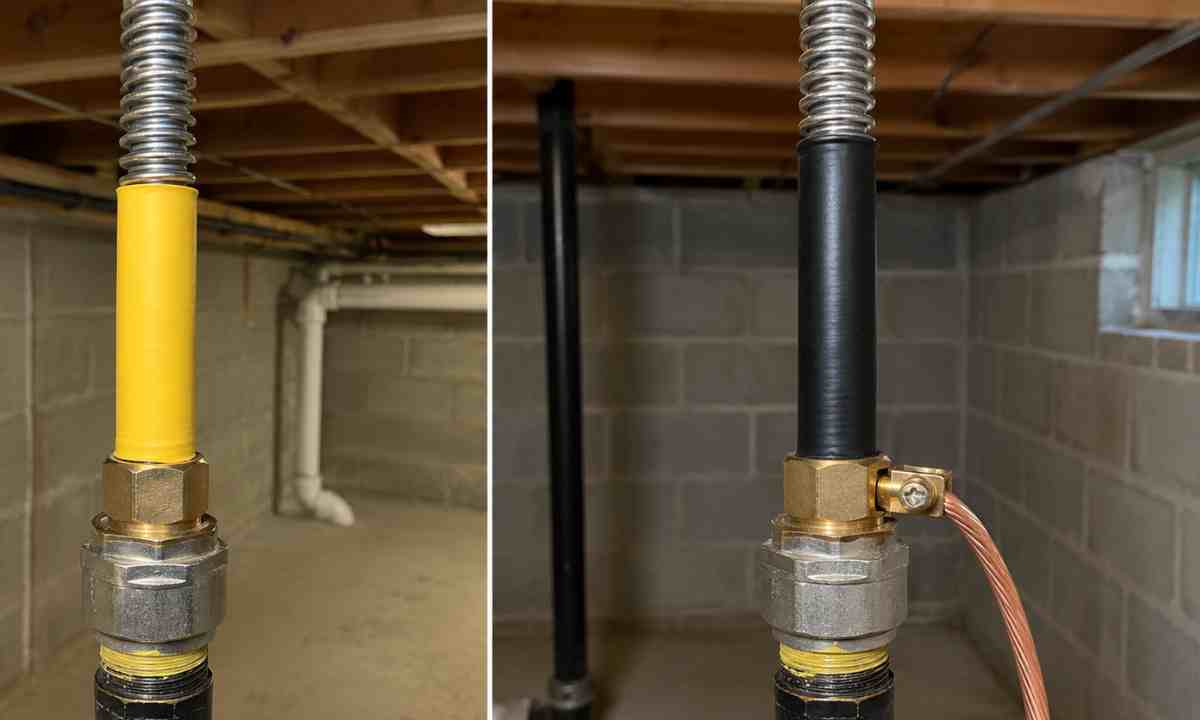
Gas piping routed through a prohibited location creates a confined-space explosion risk. Prohibited locations under §7.1 include air ducts, chimneys, dumbwaiter shafts, and solid walls where a leak would have no ventilation path.
Maryland added a CSST-specific prohibition through the Flynn and Laird Act in 2022. The law (HB 1052, effective October 1, 2022) bans non-arc-resistant yellow-jacket CSST in new construction, in renovations affecting more than 50% of total square footage, and in any system requiring a new gas line addition. Every existing yellow CSST installation must be bonded to the electrical grounding system with AWG 6 copper wire under IFGC §310.2. Only a licensed professional with both gas fitting and electrical bonding qualifications can handle this work, because proper bonding requires verifying the grounding electrode connection, not just attaching a wire.
Pressure testing and gas line purging are the two highest-risk tasks in residential gas work. Every new or modified gas piping system must be tested at 1.5 times the working pressure, with a minimum of 3 psig, using air, nitrogen, or CO2 under §8.1. Never oxygen. Oxygen under pressure in the presence of gas residue creates an ignition-ready environment. Purging follows a continuous-flow protocol under §8.3: fuel gas displaces air from the new piping while the discharge point is attended at all times and vented safely to the exterior. An improperly purged line can release an air-gas mixture within the flammable range inside the structure.
Every task on this list requires both a license and a permit in Maryland and Delaware. No homeowner workaround exists for any of them.
What Happens If a Homeowner Does Unpermitted Gas Work?
Unpermitted gas line work in Maryland and Delaware exposes homeowners to code violation fines, utility service disconnection, insurance claim denial for any gas-related damage, failed home inspection at resale, and personal liability for injury or death caused by a gas leak from the unlicensed work. These are not hypothetical outcomes. Each one has a specific enforcement mechanism.
Chesapeake Utilities and Delmarva Power, the two primary gas providers on the Delmarva Peninsula, reserve the right to disconnect gas service when unauthorized work is discovered on customer-owned piping downstream of the meter. Disconnection is not a warning. It is an immediate service action. Reconnection requires a licensed professional to bring the work into code compliance, obtain the required permit, pass the municipal inspection, and submit documentation to the utility before service is restored. That process can take weeks, and the homeowner pays for every step.
Standard homeowner’s insurance policies contain exclusions for damage resulting from unpermitted or unlicensed work. If a gas leak causes a fire and the insurer’s investigation reveals unpermitted gas piping modifications, the claim can be denied entirely. The homeowner absorbs the full cost of the damage, the remediation, and any liability to neighbors or occupants.
That denial is not a coverage reduction. It is a total loss.
At resale, unpermitted gas work creates a different problem. A home inspector who identifies unlicensed gas piping modifications flags the finding as a safety deficiency. That flag can delay closing, reduce the negotiated sale price, or require the seller to hire a licensed gas fitter to bring the work into compliance and obtain a retroactive permit before the transaction proceeds.
How Do You Detect a Gas Leak in Your Home?
Detect a gas leak through three sensory indicators: the rotten-egg odor of mercaptan added to natural gas, a hissing or whistling sound near gas lines or appliances, and visual signs including dead vegetation over a buried line, bubbling in standing water, or blowing dirt. Smell alone is unreliable because the nose stops detecting mercaptan after approximately two minutes of continuous exposure.
Watch for these indicators:
- A persistent rotten-egg or sulfur smell near gas appliances, piping, or the meter, strongest in enclosed spaces with limited ventilation
- A hissing or whistling sound near gas piping, appliance connections, or the meter, indicating gas escaping under pressure
- A localized patch of dead or dying vegetation surrounded by healthy growth over a buried gas line, caused by gas displacing oxygen at the root zone
- Bubbling in standing water near a buried gas line, or dirt blowing from the ground without wind near the line path
- A combustible gas detector alarm, which monitors methane or propane concentrations continuously and is distinct from a carbon monoxide detector
- A carbon monoxide detector alarm near gas appliances, which signals incomplete combustion rather than a raw gas leak
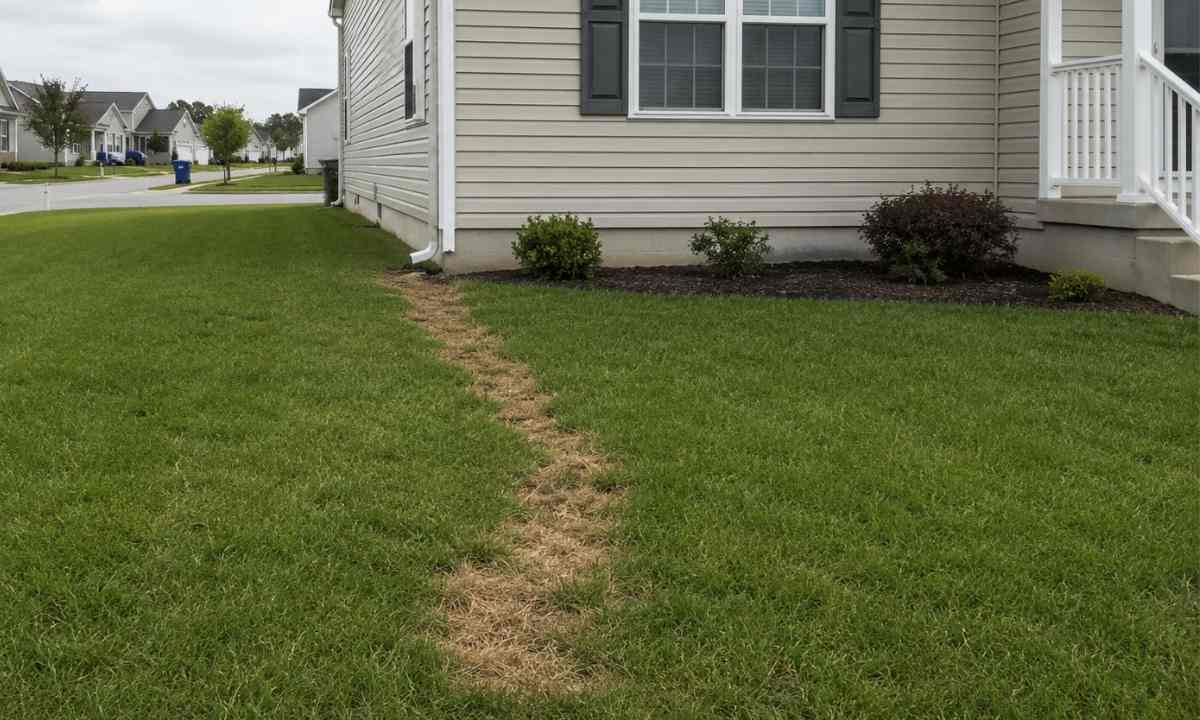
Natural gas is colorless and odorless in its raw state. Utilities add mercaptan, a sulfur-based compound, to produce the rotten-egg smell that most people associate with a gas leak. Propane receives the same treatment.
The smell is the most commonly recognized detection method, but it has three documented failure modes. Olfactory fatigue desensitizes the nose after roughly two minutes of sustained mercaptan exposure. Odor fade is a separate problem: soil conditions or old piping strip the odorant from the gas before it reaches a detectable concentration underground. Cooking fumes and cleaning chemicals can overpower whatever scent remains. Most people who experience these failures have no idea their primary warning system has stopped working.
A combustible gas detector is the only equipment providing reliable continuous monitoring for methane or propane. It is not a carbon monoxide detector. The two devices measure different gases, and one does not replace the other. NFPA 715 governs the installation standards for residential fuel gas detection equipment.
Auditory and visual indicators supplement the smell and equipment methods. A hissing or whistling sound near gas piping or the meter means gas is escaping under pressure. Outdoors, a localized patch of dead vegetation surrounded by healthy growth signals underground gas displacing oxygen at the root zone. Bubbling in standing water or dirt blowing from the ground without wind near a buried line are both documented leak indicators in safety protocols from Chesapeake Utilities and Delmarva Power.
What Should You Do If You Smell Gas?
Evacuate the building immediately without touching any electrical switch, phone, or appliance. Move to a safe distance outside, call 911 first, then call your gas utility’s emergency line: Chesapeake Utilities at 800-427-2883 for Delmarva Peninsula customers, or Delmarva Power’s emergency number for Delaware service areas. Do not re-enter until emergency responders have investigated and cleared the space.
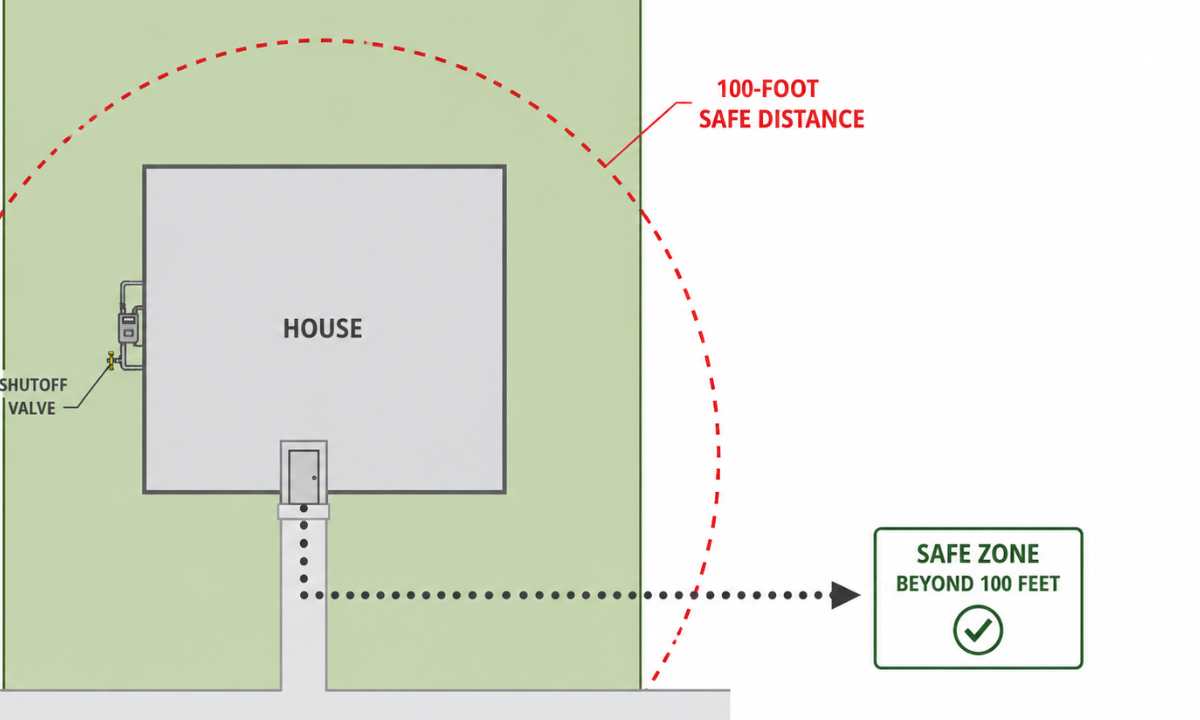
Follow this sequence:
- Leave the building without operating light switches, cell phones, doorbells, or garage door openers, any of which can produce a spark sufficient to ignite a gas-air mixture
- Leave doors and windows open as you exit to allow natural gas, which is lighter than air, to vent upward and out of the structure
- Move at least 100 feet from the building before using a phone or starting a vehicle, because vehicle ignition systems also produce sparks
- Call 911 first, then call Chesapeake Utilities at 800-427-2883 or Delmarva Power’s emergency line
- Stay outside and keep others away from the building until emergency responders clear it for re-entry
Every electrical device in a home is a potential ignition source during a gas leak. Light switches arc internally when toggled. Cell phones and doorbells produce low-voltage sparks that are invisible but sufficient to ignite a gas-air concentration at the lower explosive limit. That is why the evacuation protocol prohibits operating anything electrical inside the structure.
Every household member should know the location of the exterior gas shutoff valve before an emergency occurs. The valve sits near the gas meter on the exterior wall. Turning it a quarter-turn so the handle is perpendicular to the pipe stops gas flow.
Do not turn the gas back on yourself. Only the gas utility or a licensed gas fitter may restore service. The system must be pressure-tested after any shutoff, and each appliance must be re-lit following the manufacturer’s procedure to confirm no gas accumulated in combustion chambers during the shutoff period.
When Should You Call a Licensed Gas Fitter Instead of Waiting?
Call a licensed gas fitter immediately if you detect gas odor, hear hissing near a gas line, notice a pilot light that repeatedly goes out, see soot or scorch marks near a gas appliance, or experience unexplained headaches and dizziness near gas equipment. Schedule a non-emergency service call for annual gas line inspections, appliance age past 15 years, CSST bonding verification on pre-2006 installations, and any planned appliance additions or relocations.
The table below separates situations that require an emergency response from those that require a scheduled professional visit.
| Situation | Emergency: Call 911 and a Licensed Gas Fitter | Scheduled: Call a Licensed Gas Fitter |
|---|---|---|
| Gas odor or hissing sound | Yes. Evacuate first, then call from outside. | — |
| Pilot light extinguishes repeatedly | Yes. Indicates incomplete combustion or gas supply irregularity. | — |
| Soot or scorch marks near burners or venting | Yes. Signals carbon monoxide production from improper flame characteristics. | — |
| Carbon monoxide detector activates near a gas appliance | Yes. Indicates combustion failure producing lethal CO concentrations. | — |
| Unexplained headaches or dizziness near gas equipment | Yes. Possible carbon monoxide exposure. Evacuate and call. | — |
| Annual gas system inspection | — | Yes. Chesapeake Utilities recommends annual inspection for all customer-owned piping downstream of the meter. |
| Yellow-jacket CSST installed before 2006 | — | Yes. Bonding to the grounding electrode system must be verified by a licensed professional. |
| Gas appliances older than 15 years | — | Yes. Gas valves, heat exchangers, and flexible connectors have increased failure rates past this threshold. |
| Planned appliance addition or relocation | — | Yes. Requires BTU load recalculation, pipe sizing verification, and a permit in both Maryland and Delaware. |
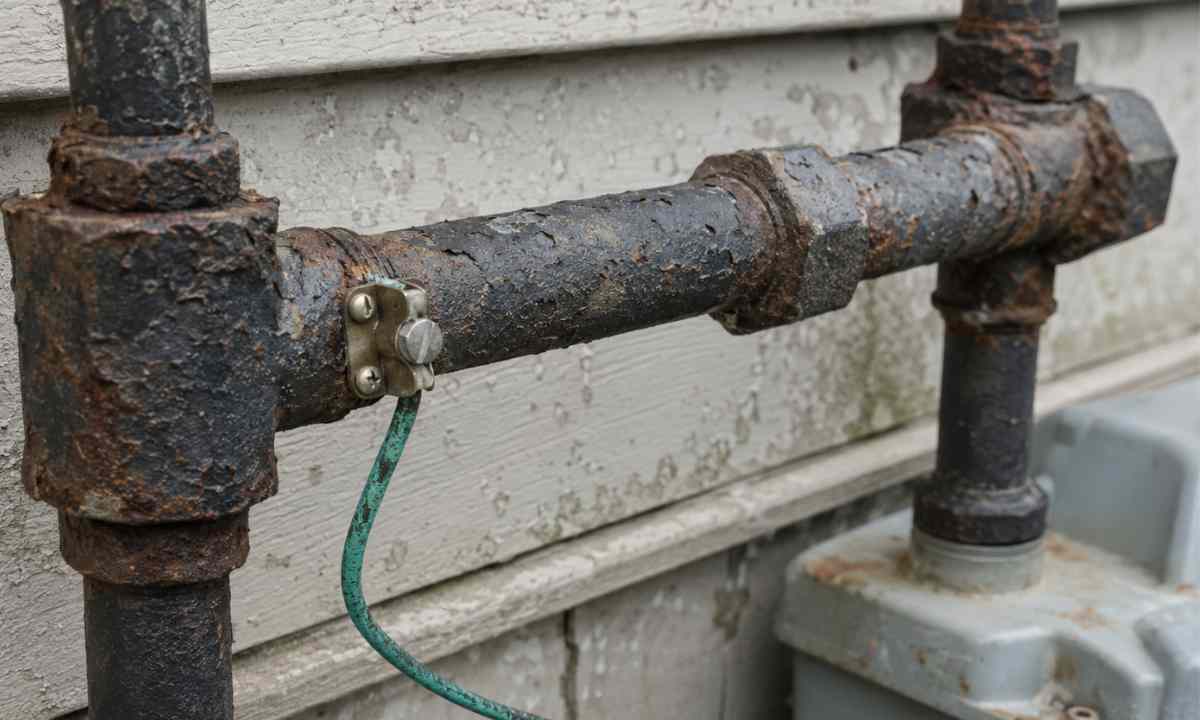
The Delmarva Peninsula’s coastal environment changes the math on the scheduled-inspection category. Salt air corrodes unprotected black iron pipe, steel fittings, and the bonding connections on CSST systems, particularly on properties within five miles of the Atlantic shoreline in Ocean City, Bethany Beach, Rehoboth Beach, and Fenwick Island. Homeowners in these coastal zones should request a corrosion-focused gas line inspection annually rather than relying on the general three-to-five year interval that applies to inland properties.
A corrosion-focused inspection covers pipe coating integrity, fitting tightness, bonding wire condition, and regulator function. 5 Star Plumbing Heating and Cooling provides 24/7 emergency gas line service across the Delmarva Peninsula for situations in the left column, and scheduled inspections for everything in the right column, including the coastal corrosion assessment.