
Salt air HVAC corrosion is the accelerated deterioration of heating, ventilation, and air conditioning components caused by airborne sodium chloride particles settling on metal surfaces in coastal environments.
On the Delmarva Peninsula, ocean winds carry salt particles inland across Worcester and Wicomico Counties in Maryland and Sussex County in Delaware. They land on condenser coils, aluminum fins, copper tubing, and electrical contacts.
The region sits between the Atlantic Ocean to the east and the Chesapeake Bay to the west. That dual-source exposure is something most coastal markets do not face. Combined with Delmarva’s high relative humidity, the salt load creates an electrolytic film that accelerates pitting, oxidation, and metal fatigue across every exposed component.
Understanding how that process works, how far it reaches, and what stops it determines whether a coastal HVAC system lasts 8 years or 15.
What Does Salt Air Do to an HVAC System?
Salt particles from ocean air settle on metal HVAC components and attract moisture, creating an electrolytic film that accelerates pitting, oxidation, and structural weakening of condenser coils, aluminum fins, fasteners, and electrical contacts.
When humidity activates that salt film, the solution acts as an electrolyte. It facilitates electron transfer between dissimilar metals, which is galvanic corrosion, or creates localized pits on single-metal surfaces, which is pitting corrosion. This process is consistent with standard electrochemical corrosion principles and runs continuously in humid coastal air. It does not require rain to start or sustain itself.
Condenser coils and aluminum fins fail first. They carry the largest exposed surface area in direct airflow, making them the most vulnerable. Copper tubing develops pinhole leaks from pitting. Steel fasteners and cabinet panels rust through. Electrical contactors and control boards corrode at connection points, producing intermittent shorts that are difficult to diagnose without pulling the unit apart.

Each failure compounds the next. A corroded contactor stresses the compressor. A pitted coil forces longer run cycles. The system does not fail all at once. It degrades in stages, each one cutting into the system’s remaining service life.
The Delmarva Peninsula sits between the Atlantic Ocean to the east and the Chesapeake Bay to the west. That position creates dual-source salt exposure that single-coast markets do not face. Prevailing easterly and northeasterly winds carry salt particles well past the beachfront. Coastal HVAC service work across Worcester and Sussex Counties confirms salt presence at communities as far inland as Salisbury, Berlin, and Dagsboro.
How Far Inland Does Salt Air Reach on the Delmarva Peninsula?
Salt air affects HVAC systems up to 10 to 15 miles inland on the Delmarva Peninsula, with the highest damage occurring within 3 miles of the Atlantic shoreline or Chesapeake Bay waterfront.
Distance from the shoreline is the single most useful variable for assessing your exposure level. Salt particulate stays suspended in the marine layer, the band of humid coastal air that ocean winds push inland, which is why corrosion damage does not stop at the visible beachfront. Field service work across Worcester, Wicomico, and Sussex Counties consistently shows three distinct damage bands.
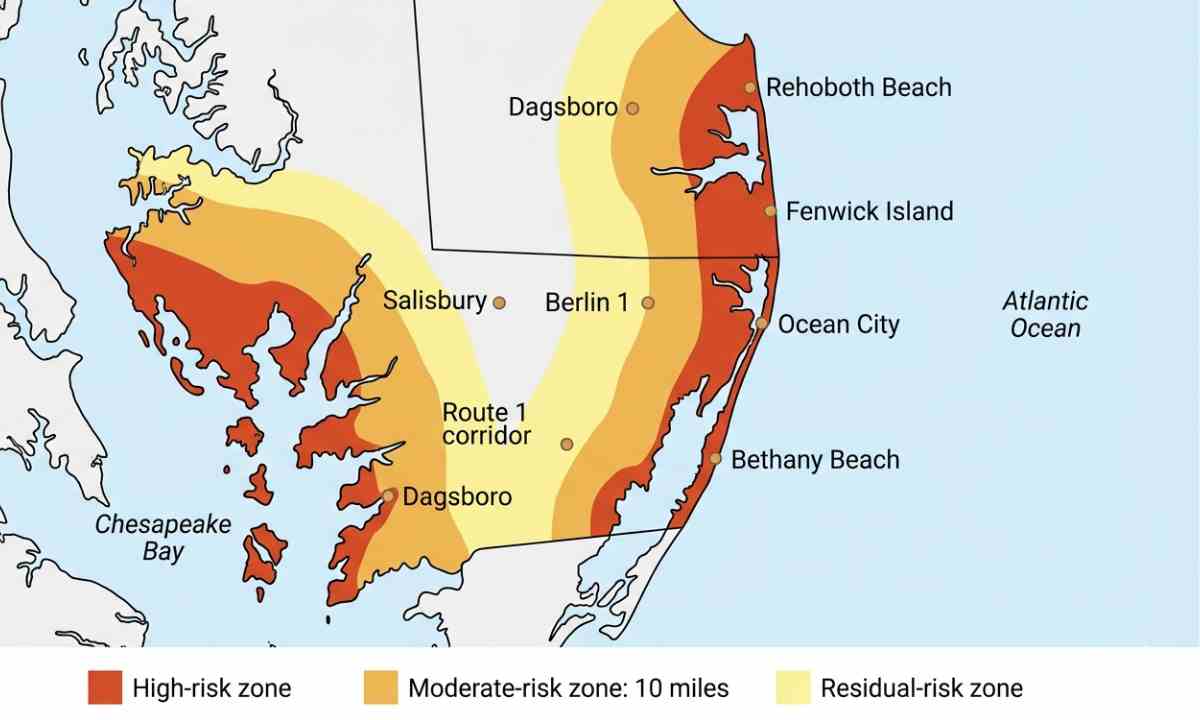
High risk (0 to 3 miles): Ocean City, Bethany Beach, Fenwick Island, and Rehoboth Beach. Direct salt spray contact at this range. Outdoor HVAC units show visible corrosion within the first season without protective measures.
Moderate risk (3 to 10 miles): Communities along the Route 1 corridor and inland towns like Berlin. Airborne salt particulate carried by prevailing easterly winds. Corrosion develops more slowly but accumulates without intervention, progressively degrading fin surfaces and reducing heat transfer efficiency.
Residual risk (10 to 15 miles): Salisbury and Dagsboro. Salt presence measurable during sustained easterly wind events. Systems here degrade faster than true inland markets but slower than the coastal band.
Delmarva adds a complication that single-coast markets do not face. Properties near the Chesapeake Bay side receive salt-laden air from the bay during storm events and sustained northwesterly winds. Wicomico County properties can draw salt exposure from both the Atlantic and the bay depending on season and wind pattern. Metal surfaces on outdoor units need time between salt deposits to dry and partially shed the electrolytic layer. Dual-front exposure shortens that interval, compressing the window before the next salt load arrives.
What Are the Signs of Salt Air Damage on Your HVAC Unit?
The earliest visible signs are rust spots or white-green oxidation on the outdoor unit cabinet and fins. Performance signs include longer cooling cycles, rising energy bills, and unusual metallic or musty odors from supply vents.
Visual corrosion on the outdoor unit typically appears before performance symptoms show up inside the home. Start there.
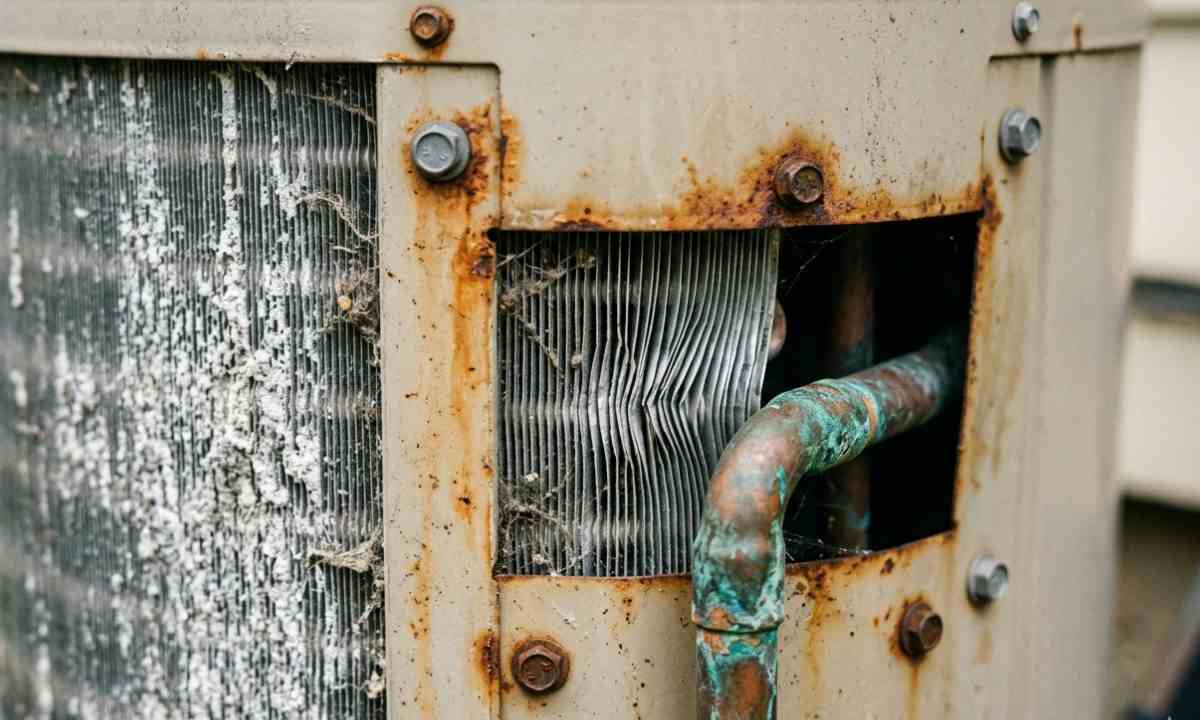
Visual indicators on the outdoor unit:
- Rust or orange discoloration on the cabinet frame and fasteners
- White powdery residue on aluminum fins, which is aluminum oxide forming on corroded surfaces
- Green patina on copper tubing and joints
- Fins that crumble or break when touched rather than bending
- Visible pitting or pinhole formation on coil surfaces, often accompanied by oil staining around coil connections or ice formation on the refrigerant line
If the outdoor unit looks clean but the system is running longer cycles, cycling irregularly, or drawing higher current than normal, check for performance signs inside the home.
Performance indicators inside the home:
- Cooling cycles running longer without reaching the set temperature
- Monthly energy bills climbing with no change in usage pattern, because corroded coils lose heat transfer efficiency and force the system to run longer to compensate
- Metallic or musty odors when the system runs, pointing to corroded internal components or mold growth in salt-contaminated ductwork
- Filters clogging faster than the manufacturer’s replacement schedule, because salt particulate and debris accumulating on corroded duct surfaces increase total particulate load beyond normal household dust
Electrical warning signs are the hardest to connect to salt damage without opening the unit. Corroded contactors and control board connections produce symptoms that look like unrelated equipment failures.
Electrical warning signs:
- System tripping the breaker more frequently than normal
- Thermostat displaying error codes related to outdoor unit communication
- Intermittent startup failures where the unit hums but the compressor does not engage
These symptoms do not resolve on their own. Corroded contactors and control board connections worsen with each salt loading cycle and require professional diagnosis before the compressor absorbs the strain.
How Does Salt Air Affect Indoor Air Quality?
Salt particles that enter ductwork and accumulate on internal HVAC surfaces increase indoor particulate levels, accelerate filter clogging, and create conditions that promote mold and mildew growth inside ducts and on evaporator coils.
Salt does not stop at the outdoor unit. Particles enter through the condenser and travel through ductwork into living spaces, mixing with dust, pollen, and other airborne contaminants.
Standard residential filtration is sized for household dust and pollen loads. Salt particulate adds a fine mineral layer that accumulates between filter fibers faster than organic particulate does, pushing total indoor particulate load beyond what standard filtration handles.
Pitting on interior duct walls creates rough surfaces that trap debris faster than smooth metal does. Add Delmarva’s relative humidity and you have the conditions that promote mold and mildew colonization inside ducts and on evaporator coil surfaces.
Mold growth on evaporator coils reduces heat transfer efficiency and restricts airflow across the coil. That compounds the efficiency loss already produced by outdoor coil corrosion. EPA indoor air quality guidance identifies elevated particulate levels and moisture accumulation as the two primary drivers of indoor air quality degradation in residential systems.
Upgrading from MERV 8 to MERV 11 or MERV 13 captures smaller particles including fine salt residue, per ASHRAE Standard 52.2. The tradeoff is increased static pressure on the air handler. Not every system can handle denser filter media without straining the blower motor or reducing airflow across the evaporator coil. Confirm static pressure capacity before upgrading.
Occupants in salt-affected homes may notice more frequent dust accumulation on surfaces despite regular cleaning, and musty or metallic odors when the system cycles. These are comfort and air quality indicators, not diagnostic conclusions. A duct inspection and air quality test establish what is actually present before any remediation decision is made.
How to Protect Your HVAC System from Salt Air
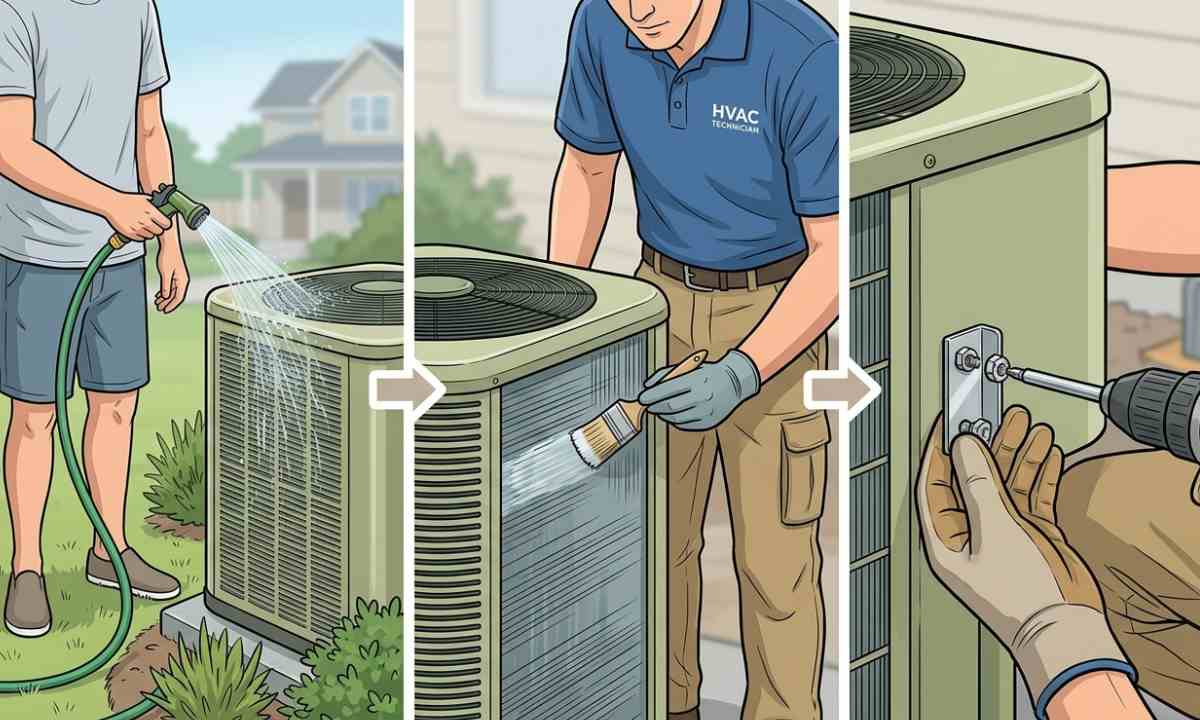
The three highest-impact protective measures are bi-annual professional coil cleaning, application of anti-corrosion coatings to the outdoor unit, and monthly homeowner rinsing of the condenser with fresh water from a garden hose.
These measures work in combination. No single action substitutes for the others. Priority order below reflects impact per dollar and frequency of execution.
- Rinse the outdoor condenser monthly with a standard garden hose to remove salt deposits before they activate corrosion. Use gentle water pressure only. Pressure washers bend aluminum fins and force salt deeper into coil gaps. Properties within 3 miles of the shoreline should increase rinsing to biweekly during summer months when salt concentration peaks along the Delmarva coast.
- Apply professional anti-corrosion coatings to the outdoor unit. Epoxy and polyurethane coatings create a physical barrier between salt-laden air and metal surfaces. Professional application involves cleaning and drying the coil surface first, then applying coatings formulated with viscosity that flows between fin gaps where corrosion initiates.
- DIY aerosol products apply at the surface layer and cannot reach the base of tightly spaced fins. Coatings tested against ASTM B117, the salt spray fog standard, provide a documented baseline of corrosion resistance. Real-world performance depends on UV exposure and humidity cycling specific to the Delmarva climate. New installations should receive coating at install. Existing systems should be cleaned, inspected, and coated during a scheduled maintenance visit.
- Replace standard galvanized steel fasteners with marine-grade 316 stainless steel screws and brackets during any repair visit. Upgrade air filters to MERV 11 or MERV 13 after confirming the system can handle the increased static pressure. Replace filters every 30 to 60 days in high-salt zones rather than the standard 90-day cycle. Seal ductwork joints to prevent salt-laden humid air from infiltrating the supply system between maintenance intervals.
Breathable unit covers protect the condenser during extended off-season periods. Standard vinyl or plastic tarps trap moisture against metal surfaces and accelerate the corrosion they are meant to prevent.
Does Salt Air Shorten HVAC Lifespan?
An unprotected HVAC system in a coastal Delmarva location typically lasts 7 to 10 years, compared to 15 or more years for the same equipment maintained with corrosion prevention measures or installed inland.
The table below puts three ownership scenarios side by side across a 15-year period.
| Scenario | Expected Lifespan | Est. Annual Maintenance Cost | Replacements in 15 Years | Est. Total Cost of Ownership |
|---|---|---|---|---|
| Inland system, standard maintenance | 15+ years | $150 to $300* | 0 to 1 | $2,250 to $4,500 |
| Coastal system, active corrosion prevention | 12 to 15 years | $400 to $600* | 0 to 1 | $6,000 to $9,000 |
| Coastal system, no corrosion prevention | 7 to 10 years | $150 to $300* | 1 to 2 | $10,000 to $30,000 |
Replacement cost range used: $5,000 to $15,000 per unit for the Delmarva market.
Corroded coils lose heat transfer efficiency before visible damage appears, meaning energy costs increase while the system still appears to be functioning normally. Efficiency loss of up to 30% has been cited for severely corroded residential coils, though a verified study specific to Delmarva conditions has not been identified. The figure is used here as a directional indicator pending source confirmation.
Emergency repair calls during peak summer months carry premium rates. A compressor failure in July on the Delmarva coast does not get resolved at standard pricing.
Most homeowner insurance policies exclude gradual corrosion damage. The language varies by policy but the pattern is consistent: corrosion that develops over time is classified as a maintenance failure, not a covered loss. The full replacement cost falls to the homeowner with no offset. Policy language varies enough between carriers that reviewing the specific policy terms is worth doing before assuming full exclusion applies.
Bi-annual professional maintenance and coating application typically runs $400 to $600 per year for a coastal Delmarva property. At that rate, 15 years of protected maintenance costs $6,000 to $9,000 total. One premature replacement at $5,000 to $15,000, before accounting for energy cost increases from efficiency loss, exceeds that figure in a single event.
What to Look for in a Coastal HVAC System
The most important features for a coastal HVAC system are factory-applied corrosion-resistant coil coatings, aluminum coils over copper for corrosion resistance, stainless steel or composite fasteners, sealed electrical compartments, and a SEER2 rating that maintains efficiency under coastal operating conditions.
- Aluminum coils over copper in high-salt zones. Aluminum resists corrosion better than copper in sustained salt air exposure. Within 3 miles of the shoreline, the corrosion resistance advantage outweighs the heat transfer efficiency difference. Beyond that threshold, the recommendation depends on maintenance frequency and coating protection level.
- Factory-applied coatings on new installations. Manufacturer coatings penetrate the coil assembly during production before final installation. Aftermarket application cannot replicate that penetration depth. Specify factory coating at purchase, not after delivery.
- Sealed or elevated electrical compartments. Salt-laden moisture intrudes at connection points first. Sealed compartments reduce exposure. Elevated compartments keep standing water away from connections during storm events.
- Marine-grade stainless steel hardware throughout. Standard galvanized fasteners corrode within the first season in the high-risk zone. Specify stainless at purchase to avoid retrofitting cost at the first repair visit.
- SEER2 rating verified under coastal conditions. High ambient humidity reduces the temperature differential the system works against, lowering effective efficiency below the rated figure. Confirm the rating applies under coastal ambient conditions, not standard test parameters.
- Ductless mini-split systems for smaller coastal properties. Fewer exterior components mean fewer corrosion exposure points. Line sets and wall penetrations still require sealing, and the indoor air handler needs the same maintenance discipline as the outdoor unit.
Position the outdoor unit on the lee side of the structure relative to prevailing easterly winds. Maintain at least 2 to 3 feet of clearance from vegetation. Elevate above grade to prevent salt-laden water pooling at the base. Relocating after installation requires concrete pad work, refrigerant line extension, and electrical conduit rerouting. These decisions are made once.